
Wholesale Guide
China produces over 50% of the world’s apparel exports. Sourcing blank apparel directly from a Chinese manufacturer gives wholesale buyers and brands access to factory-direct pricing, full customisation options, and the most complete textile supply chain on the planet. But doing it right requires more than finding a supplier on Alibaba. This guide covers everything: vetting factories, sampling, compliance, payment, and shipping.
Step 1: Understand What You Are Looking For
Before approaching any manufacturer, define your requirements clearly. Vague briefs produce vague quotes and poor samples. The more specific you are, the more accurate the pricing and the fewer revision rounds you need.
- Product type: T-shirts, hoodies, sweatshirts, joggers, or a specific category
- Fabric specification: GSM, fibre content (100% cotton, poly-cotton, etc.), yarn type
- Quantity: your target order size per style and colourway
- Compliance requirements: CE marking, RoHS, REACH, or other certifications required for your target market
- Decoration needs: screen printing, embroidery, DTG, or no decoration
- Timeline: when do you need goods at your warehouse?
Step 2: Find and Vet the Right Factory
The difference between a reliable supplier and a problem supplier is almost always visible before you place an order — if you know what to look for.
Green Flags
- Factory (not trading company) with their own production floor
- Certifications verifiable: CE, RoHS, ISO, or equivalent
- Clear, specific responses to your brief — not templated replies
- Sample lead time quoted in days, not weeks
- References from existing B2B customers available on request
- Transparent about MOQ, pricing tiers, and lead times
Red Flags
- No verifiable certifications or certificates that cannot be traced
- Prices dramatically below market — usually signals quality compromise
- Reluctant to provide samples before bulk order
- Vague or inconsistent answers about production capacity
- No factory photos, audit reports, or evidence of actual production
- Pressure to pay in full upfront before sampling
Step 3: Request and Evaluate Samples
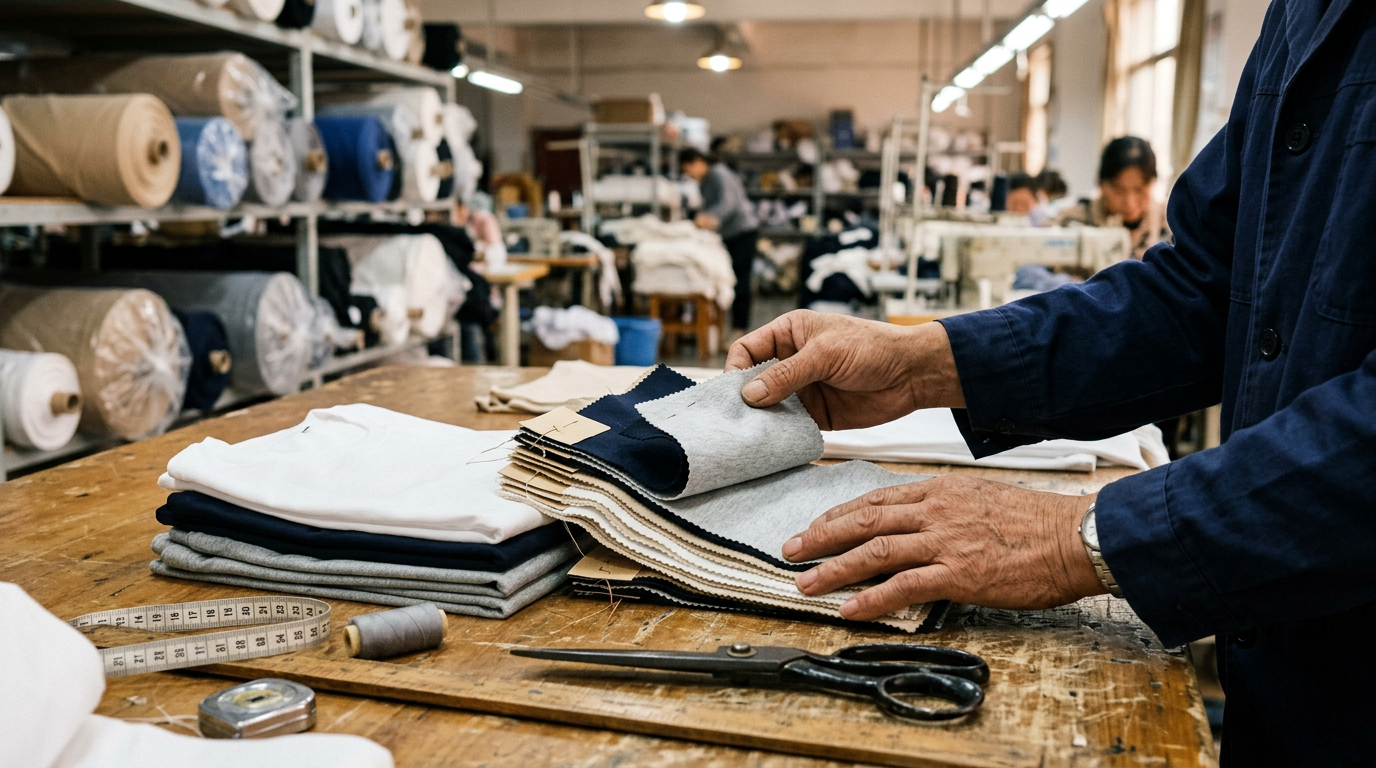
Never skip sampling. A factory that resists sending samples before a bulk commitment is a factory you should not work with. Sampling is an industry standard, and the cost (usually $20–$60 per sample including courier) is the cheapest quality assurance you can buy.
- Request samples in your target colourways — not just white or black
- Wash the sample twice at 30°C and measure before and after for shrinkage
- Check stitching: stitch count per cm, tension consistency, seam alignment
- If decoration is needed, ask for a decorated sample — not just the blank
- Compare the sample against the spec sheet you provided: weight, construction, dimensions
- If the sample does not match spec, request revision before bulk — this is normal and expected
Step 4: Verify Compliance for Your Target Market
If you are selling into the EU or UK, compliance is not optional. Selling non-compliant apparel can result in customs seizure, product recalls, and regulatory fines. Request documentation before placing bulk.
| Market | Required / Recommended | What It Covers |
|---|---|---|
| European Union | CE marking, REACH compliance | Product safety, restricted chemicals |
| EU / UK | RoHS compliance | No hazardous substances (lead, cadmium, mercury) |
| United States | CPSC, fibre content labelling | Consumer product safety, accurate labelling |
| All markets | AQL inspection report | Documented quality sampling standard |
Step 5: Agree Payment Terms
Standard payment terms in Chinese apparel manufacturing are 30% deposit on order confirmation, 70% balance before shipment. This is the industry norm — not a red flag. Here is how payment typically works:
- Deposit (30%): paid on order confirmation to begin material procurement and production scheduling
- Balance (70%): paid when goods are ready for shipment, usually against pre-shipment photos and inspection report
- Payment methods: T/T (bank transfer) is most common; some factories accept PayPal for samples; LC (letter of credit) for very large orders
- First order caution: for new supplier relationships, consider hiring a third-party inspection company (SGS, Bureau Veritas, etc.) before releasing the balance payment
Step 6: Plan Your Shipping and Lead Time
From order confirmation to goods at your warehouse, plan for 6–10 weeks total on a typical first order. Break it down as follows:
- Production lead time: 25–35 days from deposit received (varies by complexity and quantity)
- Pre-shipment inspection: 1–2 days if using a third-party inspector
- Sea freight (China to Europe): 25–35 days depending on routing (FCL or LCL)
- Sea freight (China to US West Coast): 15–20 days; East Coast 25–30 days
- Air freight: 5–7 days door to door — significantly higher cost, suitable for samples or urgent reorders
- Customs clearance: allow 3–7 days in your planning; have all documentation ready (commercial invoice, packing list, bill of lading, certificate of origin, CE/compliance docs if required)
Why Quanzhou for Blank Apparel
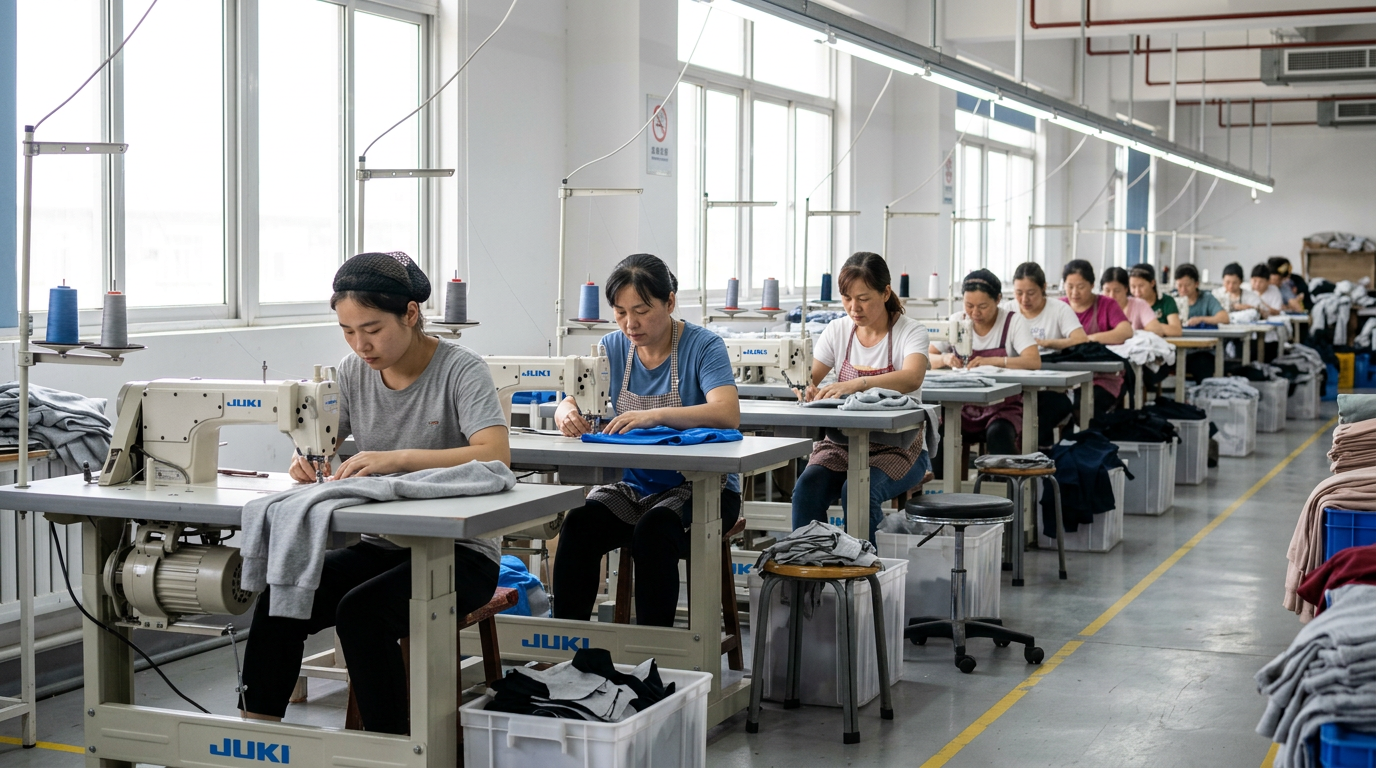
Quanzhou, Fujian is one of China’s most important apparel manufacturing hubs — home to global brands including ANTA, XTEP, and 361°, and supported by the most complete textile supply chain cluster in southern China. Factories here benefit from deep local expertise, short material lead times, and decades of export experience to EU and US markets.
- Full supply chain cluster: yarn, fabric mills, trim suppliers, decoration, and finishing all within close proximity
- Strong export infrastructure: direct access to Quanzhou Port, Xiamen Port, and major logistics hubs
- Deep experience with EU and US compliance requirements (CE, RoHS, CPSC)
- Competitive on quality-to-price ratio at the 100–5,000 pcs MOQ range
Frequently Asked Questions
How do I know if a Chinese factory is legitimate?
Ask for their business licence (营业执照), verifiable certification documents, factory photos, and references from existing customers. Legitimate factories will provide these without hesitation. You can also verify Chinese business registrations through the National Enterprise Credit Information Publicity System (gsxt.gov.cn).
What MOQ can I expect from a China blank apparel manufacturer?
For private label blanks (relabelling only), MOQ typically starts at 100 pcs per colourway. For custom cut-and-sew OEM silhouettes, expect 300+ pcs per style. At DRIOV, our standard MOQ is 100 pcs for private label and 300 pcs for custom OEM manufacturing.
Do I need an agent to source from China?
Not necessarily. Many brands work directly with Chinese factories without a sourcing agent. Factory-direct relationships reduce cost and improve communication. A sourcing agent adds value when you are managing multiple suppliers, need local language support, or are sourcing highly specialised categories. For standard blank apparel, direct factory contact is usually sufficient and more cost-effective.
DRIOV is a factory-direct blank apparel manufacturer in Quanzhou, China.
CE & RoHS certified, 300+ brands served, 2M+ pieces per year. We offer transparent pricing, detailed sampling, full compliance documentation, and a dedicated English-speaking B2B team. Send us your brief →